

- Key insight: Despite dozens of broker-dealers crossing preliminary disclosure thresholds designed to curb predatory practices, FINRA’s Rule 4111 has designated only two restricted firms in five years.
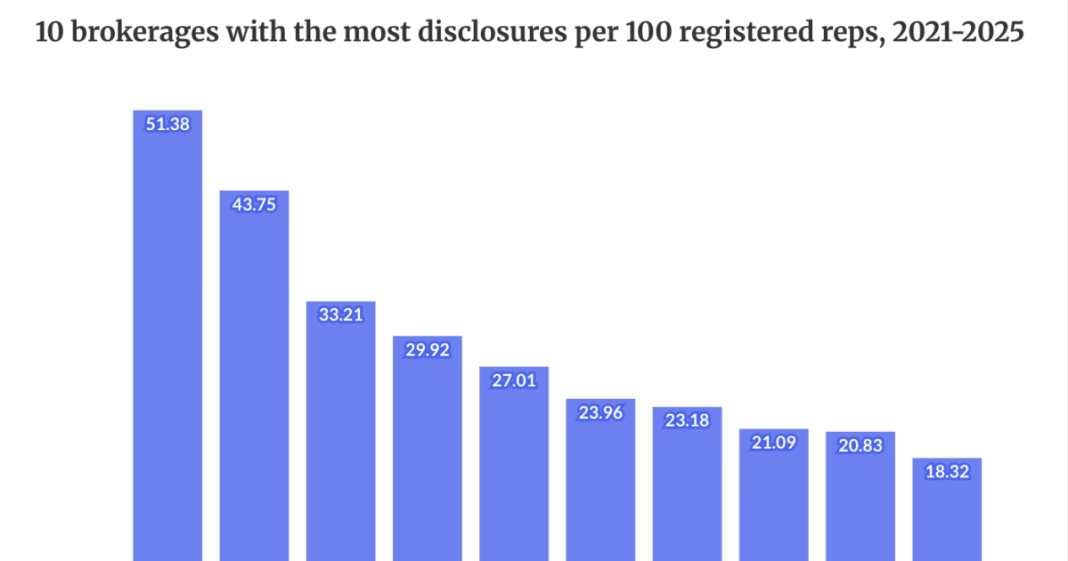
- Supporting data: AdvizorPro identifies at least a dozen brokerages where at least 10% of registered reps had customer complaints or regulatory disclosures, with the firm with the highest disclosure ratio logging more than 51 disclosures per 100 brokers.
Although a small number of broker-dealers have enough investor complaints and other disclosures to raise federal regulators’ eyebrows, none has landed on FINRA’s naughty list for possibly wayward firms.
Processing Content
According to an analysis of broker disclosures by the data firm AdvizorPro, at least a dozen firms have racked up enough adjudicated events or complaints not yet settled to potentially trigger a Financial Industry Regulatory Authority rule meant to label firms that could do significant investor harm. Yet since FINRA’s adoption five years ago of its Rule 4111 allowing regulators to affix a “restricted” label on brokerages, only two firms have been pinned with it.
One of them, Reid & Rudiger, has been expelled from the industry and is thus no longer capable of causing investor harm. The other, Spartan Capital Securities, has managed to have the restricted designation temporarily removed.
Meanwhile, AdvizorPro’s research of brokerages with at least 100 registered representatives uncovered a handful with enough customer complaints and other disclosures from 2021 to 2025 to most likely merit preliminary scrutiny under FINRA’s rule.
FINRA’s infrequently used restricted label for high-risk firms
Rule 4111, which went into effect at the start of 2022, allows regulators to affix a “restricted” designation to brokerages deemed a high risk to the investing public. Firms given the label may have to set aside money to pay restitution to investors, find themselves subject to frequent regulatory examinations and even be placed on a track toward industry expulsion.
In the interest of letting the investing public know which firms have raised the suspicions of regulators, a 2023 revision to the rule allowed the restricted label to be posted to individual brokerages’ pages on FINRA’s BrokerCheck online database. But so far, there have been few appearances of these “scarlet letters.”
FINRA’s Rule 4111 lists a bewildering nebula of criteria that can be used to designate brokerages as preliminary candidates for the restricted list. Firm’s size and types of disclosures both matter. Firms with 500 or more registered representatives can qualify for the restricted label, for instance, if they have more than 10% of reps have had disclosures resulting in adjudication against them, or 5% with pending complaints not yet settled.
But brokerages that cross one or more of the thresholds still have many steps they can take to avoid the label or file an appeal after receiving it.
Craig McCann, the president of the research group SLCG Economic Consulting and a frequent critic of FINRA, has worked with colleagues to compile similar lists of
McCann said the complexities of the new rule seemed almost designed to give firms myriad ways they can “easily and purely superficially avoid” the restricted label. To demonstrate that a given brokerage warrants it, McCann said, regulators have to do much more than show a firm meets “a threshold percent of brokers with complaints.”
“The whole system looks like FINRA is doing something, but it is actually doing nothing,” McCann said.
FINRA declined to comment for this article.
Exactly what might land a brokerage on FINRA’s restricted list?
In its analysis of FINRA data, the research firm AdvizorPro found 20 brokerages that had 10 or more disclosures per 100 registered representatives from 2021 to 2025. Brokerages merit preliminary scrutiny under FINRA’s Rule 4111 depending on their size and if they meet various criteria tied to six factors.
These include whether they have advisors who have:
- Been the subject of an “adjudicated” event, including an adverse arbitration award or civil judgment, a settlement for $15,000 or more, a regulatory action from the SEC or other regulator or a criminal matter.
- Had “pending events” filed against them in a civil court for an investment-related matter, by any regulator or by a criminal court.
- Been terminated after an internal review by their employer uncovered fraud, securities or investment infractions or violations of industry-conduct standards.
- Been registered for at least one year with a brokerage that was expelled by FINRA in the past five years.
Firms can also come under preliminary scrutiny if they have been through or are undergoing adjudication or have pending events.
Firms then have different thresholds to cross to trigger preliminary scrutiny depending on how many registered representatives they have. For brokerages with 500 or more registered reps, they must have 10% or more of their reps with a so-called adjudicated event — a complaint resulting in an adverse award, civil or criminal judgment, regulatory action or settlement for $15,000 or more. Alternatively, they can have 5% or more of their reps subject to a pending event or 10% or more who were fired following an internal review.
Once a brokerage has been deemed worthy of preliminary scrutiny, FINRA then reviews its disclosures, calculates how much it should set aside for possibly harmed investors and gives the firm an opportunity to rebut the findings. Brokerages can avoid the restricted label by taking steps like firing representatives with regulatory dings. Even after being deemed restricted, firms can appeal and win a reprieve.
Of the 10 firms with the highest concentrations of disclosures from 2021 to 2025, all had more than 20 disclosures per 100 registered representatives, according to AdvizorPro’s numbers. The No. 1 firm, Emerson Equity, had just over 51 disclosures per 100 registered reps; the second, Newbridge Securities, had just over 43.
Of the 10 brokerages topping AdvizorPro’s list, the only one to respond to inquiries was Centaurus Financial. Paul King, general counsel for Centaurus, questioned whether disclosures per registered reps is truly a good gauge of risk to the investing public.
Why not all BrokerCheck disclosures are created equal
According to AdvizorPro’s numbers, Centaurus had just over 33 disclosures per 100 registered reps from 2021 to 2025. Yet AdvizorPro’s data shows that those disclosures were attached to only about 15% of the firm’s registered representatives during that period. King said most of the disclosures on Centaurus reps’ regulatory records stem from the failure of a high-yielding debt instrument known as L Bonds.
King noted that dozens of other firms have regulatory dings related to L Bonds, on which the now-defunct alternative asset manager GWG defaulted in early 2022 before declaring bankruptcy a few months later. With most Centaurus disclosures tied to that single failed investment vehicle, “Any metric that allows disclosures attributable to that small group to reflect adversely on the more than 85% of Centaurus representatives with no disclosures of their own is misleading, logically unsound and fundamentally unfair,” King said.
King also noted that Centaurus and its representatives were not the subject of a single adverse award or judgment handed down against it during the same period.
“Not one,” King said.
What Centaurus and its representatives did have from 2021 to 2025, though, were millions of dollars in settlements. And not all of them were related to GWG L Bonds. In 2023, for instance, the Securities and Exchange Commission settled with two Centaurus brokers for nearly $350,000 over allegations that they had placed clients in overly risky variable interest rate structured products. One of the brokers in the case, Ricky Mantei, has 45 disclosures on his record. Most of them are from settlements.
In responses to many of the disclosures posted on BrokerCheck, Mantei said he vehemently denied committing any wrongdoing. He said he was dragged into the disputes simply because of his position as a branch manager and that he had no “direct or indirect relationship or contact with the claimant.”
“Notwithstanding, in an effort to avoid protracted proceedings, and the time and financial resources required, and in an effort to reach an expedited resolution with the customer, my broker/dealer unilaterally and without my agreement, settled with the customer, to which I made no monetary contribution,” Mantei repeated in many of his comments.
A common provision in settlements with the Securities and Exchange Commission or other regulators is a disclaimer saying the firms and advisors involved neither admit to nor deny allegations against them. (The SEC in May this year revoked its previous policy forbidding firms
What about all the firms with no regulatory disclosures?
But even if settlements aren’t necessarily indicative of wrongdoing, one big question remains, says Michael Bixby, the president of the Public Investors Advocate Bar Association. Why do some firms have such a higher concentration of disclosures than practically everyone else in an industry with nearly 3,200 firms and 640,000 registered representatives? For instance, LPL Financial — the largest broker-dealer in the industry — has just under 4 disclosures per 100 registered representatives.
Bixby said he doesn’t buy the notion that brokerages with unusually large numbers of customer complaints have simply been the victims of frivolous litigation. Sure, he said, a firm or advisor may on very rare occasions be hit with a complaint with no legitimacy.
“But it doesn’t make sense to me that you have such aberrations for these people up at the top,” said Bixby, the founder of Bixby Law in Pensacola, Florida. “These people should go out and buy a lottery ticket if it just so happened that they had 150 complaints that were wrongfully filed against them.”
Brokerages can inherit disclosures from previous firms
Another complication is the near absence of vetting of customer complaints before they’re recorded in FINRA’s Central Registration Depository — the vast regulatory database behind FINRA’s public-facing BrokerCheck website. FINRA has a policy of posting virtually all complaints, even those that brokers and brokerage firms
If a firm or advisor denies the validity of a claim and the aggrieved investor doesn’t want to pursue the matter further, then the denial is noted on BrokerCheck. Advisors can also submit a written explanation presenting their side of the dispute.
Dochtor Kennedy, the founder of AdvisorLaw and a frequent defender of brokers in FINRA arbitration cases, said there’s no good way to look at BrokerCheck and discern which firms have a lot of disclosures resulting from legitimate complaints and which simply felt an obligation to report everything.
“I’d love to tell you, you know, there is an actual metric, it’s quantifiable, you can figure it out,” Kennedy said. “But if there is, I have yet to find it. And I’ve been doing this for a while.”
King said Centaurus takes its duty to report customer complaints to FINRA very seriously. “Other firms may not,” he said.
Both King and Kennedy also noted that many advisors carry regulatory disclosures from customer complaints that were lodged before they joined their current firms. The most a brokerage can be faulted with in such cases is for bringing on someone with a blemished record.
One of FINRA’s primary goals in adopting Rule 4111 was to combat a phenomenon known as “cockroaching” — the tendency of brokers with questionable regulator records to gather together with similarly tarnished colleagues at a new firm once their old one has been shut down.
Academic researchers have frequently suggested that advisors with actual records of misconduct are more likely than others to commit a subsequent offense. A
Firms that specialize in giving brokers a ‘second chance’
Despite such tendencies, some firms have, in fact, made it a point to at least consider hiring advisors who had to leave a previous firm following customer complaints. International Assets Advisory, where slightly more than 11% of the registered representatives have at least one disclosure, deems itself in part a “second-chance firm,” according to President and Chief Operating Officer Matthew Lampman.
The vast majority of the BrokerCheck disclosures for the firm’s brokers occurred at their previous employers, Lampman said. Lampman said International Assets Advisory’s policy is to vet potential hires’ disclosures for evidence of real investor harm. Anyone plausibly suspected of adversely affecting clients’ interests is someone “we steer clear of,” he said.
“And we always say we give second chances, but we don’t give third chances,” Lampman added.
Arkadios Capital, where 8.8% of the registered representatives had at least one disclosure from 2021 to 2025, similarly has a policy of not turning away advisors with customer-complaint baggage. Spencer Pryor, chief legal and corporate strategy officer, said that of the 30 Arkadios brokers who logged disclosures from 2021 to 2025, only five got them for conduct that allegedly occurred at Arkadios.
That means only 1.76% of Arkadios’ 284 registered representatives were hit with a complaint while actually at the firm. Meanwhile, “None of the 25 RRs whose disclosed conduct predates their Arkadios registration have had an additional disclosure while registered with Arkadios,” Pryor said.
How Spartan Capital got its restricted label rescinded
Even after FINRA deems a firm “restricted,” Spartan Capital’s case shows there are difficulties in getting the label to stick.
New York-based Spartan Capital was put on the restricted list in February and ordered to set aside $1.85 million for investor protection after finding that it had exceeded a couple of its criteria for preliminary scrutiny under Rule 4111. Specifically, FINRA found that roughly 10% of Spartan’s brokers came from previously expelled firms (exceeding the threshold of 3% for firms of its size) and 10.9% were faced with a pending regulatory event (exceeding the threshold of 5%).
In a hearing to contest the restricted label, Spartan Capital presented evidence that some of the disclosures logged against its brokers were duplicative. Others were recorded for brokers who had already left the firm.
After hearing the arguments, FINRA Deputy Chief Hearing Officer Carla Carloni
FINRA, Carloni wrote, “failed to demonstrate by a preponderance of the evidence that it properly designated Spartan Capital as a Restricted Firm and imposed a maximum Restricted Deposit Requirement of $1,851,000 in accordance with FINRA Rule 4111.
“While there is some compelling evidence to support these findings, the record in this matter contains inconsistent information in some Rule 4111 metrics and a lack of clarity in others.”
Introductory bullet points created by AI with editorial review.